
 At eleven years old, I knew how to hold my own bag. I knew how to stay close to my parents. I knew how to listen without understanding, how not to cry when adults spoke over my head in a language that moved too fast.
My family of nine had crossed the South China Sea on a wooden fishing boat and entered a country still bleeding from a war it was desperate to forget. We arrived with the clothes on our backs and papers that mattered more than anything we owned. Papers that said we were permitted to stay. Before we spoke English, before we understood how silence traveled in American rooms, we understood that those documents were not symbols. They were shelter.
The small Minnesota town we were sent to had never seen people like us. That was intentional. The U.S. government scattered Vietnamese families across the country so no single place would feel overwhelmed, so the presence of refugees would be absorbed quietly. I understand the policy now. But at the time, it meant only this: we were alone.
Our new neighbors were not cruel, exactly. But even as a child, I felt the unease: the way the grocery clerk’s smile tightened when my mother counted coins too slowly, the way elderly men paused their conversations as we walked past, the way gratitude was expected to run only one direction. At home, my parents spoke softly about “making do,” about not causing trouble, about how lucky we were to be here. Their voices carried both relief and something like fear, as if the ground beneath us might shift if we stepped too heavily.
My mother worked as a maid and scrubbed grease traps before dawn. My father collected garbage in a uniform that still smelled even after she washed it twice. In Việt Nam, he had been a government officer. In Minnesota, he lifted garbage cans as tall as himself while his coworker stayed warm inside the truck. We smiled through Thanksgiving food that tasted like nothing we knew, said “yes, yes” to questions we didn’t understand, and learned to make ourselves small enough to fit the space this country reluctantly gave us.
Years later, I read the 1975 Gallup poll taken in May of that year, while my family was still in transit through the processing camp in the Philippines, that confirmed most Americans had opposed our arrival. The knowledge settled without shock, explaining things I had always felt but couldn’t name. What surprised me most was not that the opposition existed, but that the country acted anyway.
Against the current of the moment, the United States chose to let us in—not because it was popular among the American people, but because some decisions outlast the mood that surrounds them. Because sometimes a country moves forward not with confidence, but with reluctance, and discovers only later what it made possible.
I think about that now, as immigration is again framed as crisis and threat, as numbers crowd out names, as legality is spoken of as certainty rather than the fragile condition it has always been: a piece of paper, a signature, a stranger’s willingness to say yes when the easier answer was no.
I recognize the language. I recognize the fear. I grew up inside its consequences.
Fifty years have passed since the day my family of nine came to this country. Vietnamese refugees are woven into American life in ways no poll predicted. My siblings and I became an architect, an engineer, a teacher, a safety instructor, an administrator, a designer, and a nurse. My son Khánh designs the digital interfaces millions of people use every day without ever knowing his name. My son Việt is a robotics engineer and lives in Hồ Chí Minh City, running a nonprofit that teaches English to underprivileged children. My daughter Thư, twenty-seven now, works in human resources. She watches the news and asks me questions I don’t know how to answer.
But what I do know is how I felt at eleven years old, arriving in a country where the public was tired, where jobs were scarce, where sympathy for my family was thin and frayed, stretched across fresh grief and resentment. I know what good can happen in the space between what a country feels in a given political moment and what it decides to do in spite of those feelings, in the distance between fear and what becomes possible when fear is not allowed to win.
___
Minh Nguyễn is a Vietnamese American architect and writer based in San Diego. He arrived in the United States in 1975 as a refugee. His essays have appeared in AARP The Magazine, with a piece in the August/September 2026 print issue. He has completed a memoir, Streets Paved With Gold, represented by D4EO Literary Agency.
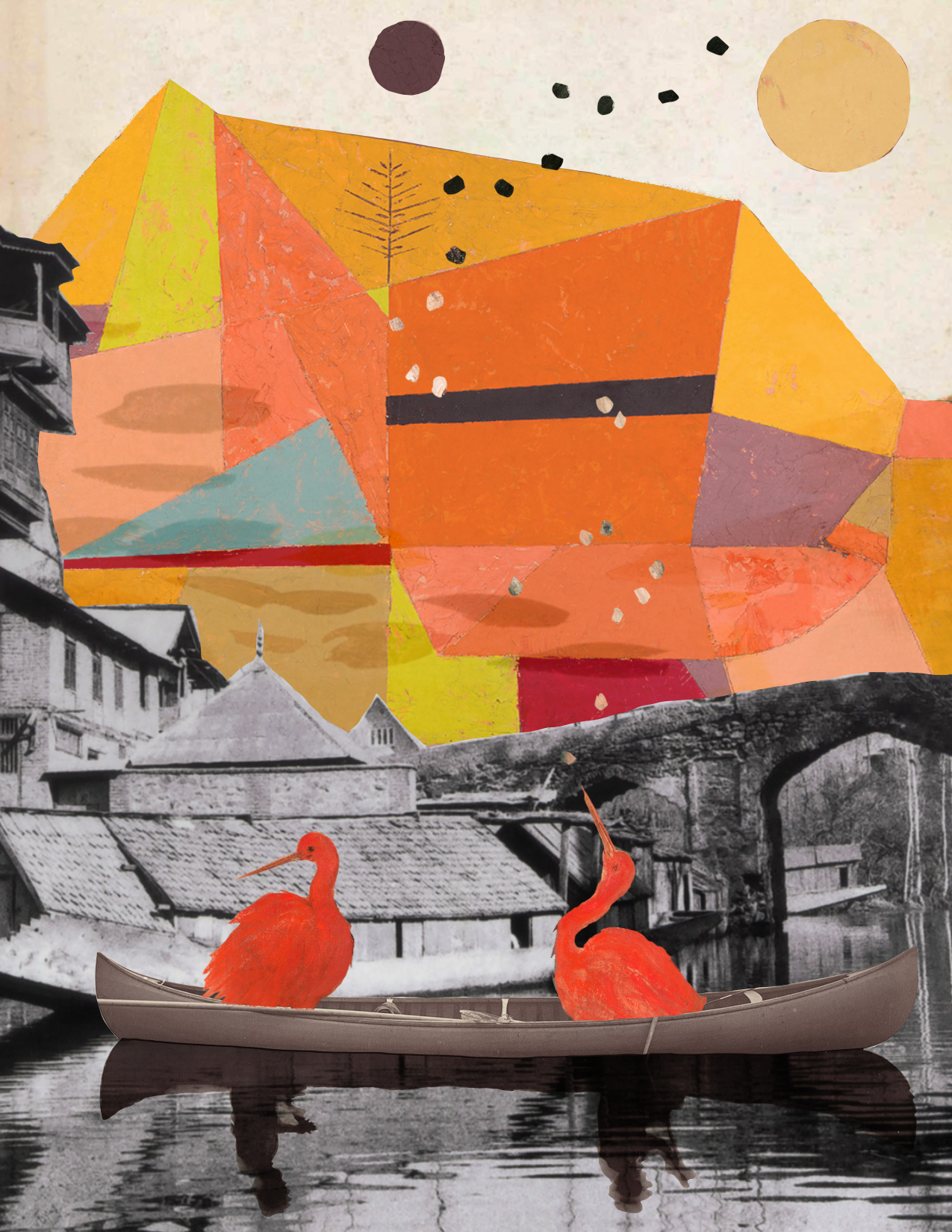
Artwork by Meera Lee Patel
25 comments
Etya Krichmar says:
Sep 15, 2026
What a great essay! As a refugee myself and a proud American citizen, I can relate. The legal papers issued by the US government for my family opened the doors we had never imagined to walk through in the Soviet Union. Thank you for sharing this heartfelt story.
Minh Nguyễn says:
Sep 16, 2026
Thank you so much for this generous note. It means a great deal to hear from someone whose own writing speaks so honestly about growing up Jewish in the Soviet Union and the long shadow of antisemitism. Refugees understand something particular about what it means for a country to open its doors, and I’m grateful our experiences meet in that space. I’m honored the essay resonated with you, and I appreciate you taking the time to say so.
Mary McGee says:
Sep 15, 2026
Beautfiul, Minh, thank you for writing this!
Minh Nguyễn says:
Sep 16, 2026
Thank you for taking time to read it.
Krista Puttler says:
Sep 16, 2026
Thank you so much for writing this. I am hopeful even if the space is small right now. There is still a space.
Minh Nguyễn says:
Sep 18, 2026
Thank you for reading and for saying that. “There is still a space” is exactly the note I hoped this piece would leave someone with, so it means a lot to hear it back.
Sarah Barbo says:
Sep 17, 2026
I am incredulous how you pinpointed this space and put it into words: “I know what good can happen in the space between what a country feels in a given political moment and what it decides to do in spite of those feelings…”
It makes all the seemingly complexity and gray areas of this moment appear rather straightforward. Thank you for sharing.
Minh Nguyễn says:
Sep 18, 2026
Thank you for this. That gap between feeling and action is where I’ve always found the most honest evidence of who we actually are, so I’m glad the line landed for you. I appreciate you taking the time to write.
marcia aldrich says:
Sep 17, 2026
I am so glad to have read your incredibly intelligent and insightful essay. I can only wish more people thought as you do.
Minh Nguyễn says:
Sep 18, 2026
Thank you, that’s kind of you to say. I’m glad it resonated with you.
Gary Oshima says:
Sep 18, 2026
Very well written, Minh. Although I knew some of your story when we worked together, this piece is very enlightening and poignant now.
Minh Nguyễn says:
Sep 18, 2026
Good to hear from you, and thank you for reading. It’s strange putting a piece of your own history out into the world for people to see, so it means something that it landed with someone who knew me back then. Hope you’re doing well.
Jan Garvey says:
Sep 18, 2026
In 1980, my husband and I welcomed 4 Vietnamese refugees (“boat people”) into our home. They lived with us 7 months, learning English, receiving medical and dental care, and absorbing our Tennessee culture. They were appreciated everywhere, as most Americans were moved by the horrors endured by the boat people. In time, they chose to relocate in Los Angeles in the Asian culture there. Their children went to Ivy League colleges, becoming respected professionals. We are still in touch. We consider sponsoring them to be one of the best adventures of our lives.
Minh Nguyễn says:
Sep 18, 2026
Thank you for sharing this, and thank you for what you did in 1980. Stories like yours are the other half of what I was trying to write about. My own family’s sponsors are part of the memoir I’ve just finished, so reading this hit close to home. I’m glad you’re still in touch after all these years.
Dorothy says:
Sep 20, 2026
“the distance between fear and what becomes possible when fear is not allowed to win.” I had not thought of not letting fear win as a choice before. I wonder how we help people see that behind their biases and bigotry is a fear that they are allowing to win. Beautiful piece. I will look for your memoir.
Minh Nguyễn says:
Sep 21, 2026
Thank you, Dorothy, that question you’re raising, what’s underneath bias and bigotry, is exactly the kind of excavation I saw described in your own writing, going toward the fog until the details clear. I don’t have an answer, but I think naming fear as a choice rather than a given is already most of the work. I’d be glad to have you read the memoir when it’s out.
Suzanne Farrell Smith says:
Sep 21, 2026
Beautiful, powerful, important, all the things. How you managed to pack so much into a flash is remarkable. It’s what I love so much about flash, the compact vibrance and energy. I hope your piece is read far and wide.
Minh Nguyễn says:
Sep 21, 2026
Thank you, Suzanne, that means a great deal coming from you. I’ve since looked into your work, The Memory Sessions in particular speaks to something I’m chasing in my own writing, how much of childhood we carry that we can’t fully retrieve or explain.
Minh Nguyễn says:
Sep 21, 2026
Thank you, Suzanne, that means a great deal coming from you. I’ve since looked into your work, The Memory Sessions in particular speaks to something I’m chasing in my own writing, how much of childhood we carry that we can’t fully retrieve or explain.
Joseph Zignego says:
Sep 22, 2026
I knew Minh as childhood friend, very smart, caring, and lots of stuff happening in his life traveling to the USA, and then Red Wing. We both WON. You got a country to stay in and we look at all the building your company MNN GROUP,INC has built.
Minh Nguyen says:
Sep 24, 2026
Ziggy, so good to hear from you. “We both won” says it perfectly. I think about Red Wing more than people would guess. Thank you for reading and for remembering that kid.
Nancy Glass says:
Sep 22, 2026
I remember when a single Vietnamese family was brought to my small hometown along the Texas coast. My parents took me to meet them and take some furniture my dad had gathered for them from our neighborhood. The father became a skilled and respected furniture refinisher, all of the children attended college and the son I knew best became first a nurse and then a surgical equipment specialist; two decades after their arrival, I was thrilled to be invited to his wedding. As a family, they contributed so much to our society. I am grateful for their determination.
Minh Nguyễn says:
Sep 24, 2026
Thank you, Nancy, for sharing this and for what your family did. Every one of these comments is teaching me how many small, ordinary acts of welcome were happening all over the country at the same time as ours, and how much they mattered. That family’s story, and yours in it, is the other side of what I was trying to write. Grateful you shared it.
JQ says:
Oct 2, 2026
Beautifully written and reliable in all ways.
Minh Nguyễn says:
Oct 6, 2026
Thank you. “Reliable” is a word I’d love to have on my work, because truth is what I’m after when I write about my family. I’m grateful you felt it.