
 “I hope you don’t mind,” she says. “I went ahead and added this floral embellishment.” Ellen runs her fingers, nails painted pale pink, over the silicone-studded band that will keep my custom compression garment snug around my right thigh.
Ellen is my new garment fitter. She parts her hair and color-coordinates her outfits the way professional, confident women do. Her shoes match her belt. Her belt matches the silk scarf loosely knotted around her neck. She looks at me. I look at her.
“Try it on,” she says, flashing her beautiful veneers. She closes the door behind her.
I bend over to take off my beat up Adidas, staring past my misshapen socks hiding my misshapen feet. I’ve been wearing a compression garment since I could crawl. I was born with a rare vascular disorder. It’s genetic, a random mutation. 1 in 100,000. That statistic has never made me feel special.
I take off my socks, careful to avoid touching my feet. Whenever I have to, I touch them the same way I hold a dead mouse when I carry it from the trap to the garbage. I hate my compression garment. I hate the sound of the word garment. I hate that my dependence on these German-made elastic tubes robs me of the ability to squish sand in between my toes at the beach, makes it impossible to outrun would-be murderers when I’m walking home alone late at night.
I stand up and undo my pants, pushing them below my boyish hips. They drop to the floor. I sit on an exam room bed covered with disposable paper, which crinkles before ripping under my weight. I peel off my old garment. Thanks to my struggling lymphatic system, my right leg looks like it belongs to a water-logged corpse. As I turn the new garment inside-out, I look past my bloated leg at something or maybe nothing at all.
When I was a kid, my mom hid my garments and my swelling and my birthmarks and all the parts of me that make strangers look away under long pants and close-toed shoes. On hot days, under long shorts and knee-high socks. That’s how she sent me to school. If nobody knew, maybe I wouldn’t get laughed at. Maybe I’d get invited to birthday parties. Maybe someone would ask me to the dance. She hid me until I could hide myself. All I have ever known is how to hide.
I shove my toes into the garment. My big toenail is cracked, ingrown. When I was young, cosmetic surgeons said they could make me look less like me, more like everyone else. They lied, leaving scars I still wince at decades later. “You won’t be getting pedicures anyway,” one said. When there was nothing more they could do to fix me, they told me I was lucky I could cover up my disability.
I pull the garment over my swollen leg, adjusting the heel and smoothing out the creases like a frustrated mom brushing out her daughter’s ratty hair. Sometimes I daydream about having a disability I can’t cover up. About having no choice but to show you who I am from the get go so you can reject me or tell me you’re sorry or pretend I don’t exist. So I don’t have to feel the guilt of hiding, of lying to you. But when I think about being seen I go rigid with fear.
I secure the floral band around my upper thigh and look at it. Ellen doesn’t understand my fear. But she’s right. The flowers are pretty. She knocks and comes in at the same time, the way doctors do. Still wearing no pants, I stand up and position myself in front of a full-length mirror. She looks at my reflection.
“How does it fit?”
“Well.”
“And the flowers! Why not?”
Because, I want to tell her, flowers are for people who want to be noticed. Beauty pageant winners, dead people in coffins, little blond girls in stock photography. Had I been born in a different place or at a different time, I would have been euthanized, drowned, or otherwise abandoned at birth. Flowers are not safe for people like me.
“I think they look nice,” she says, tilting her head.
I tilt my head in the opposite direction, staring at an ad for post-mastectomy bras that I don’t really see, and smile. My practiced, polite smile.
___
Krista Raspor is a creative nonfiction writer living in Toronto. Her work has been featured in Brevity Magazine, Lunch Ticket, The Fiddlehead, Beaver Magazine, The Globe and Mail and others. She writes about living with a disability, travel, and the little moments that get big when examined closely.
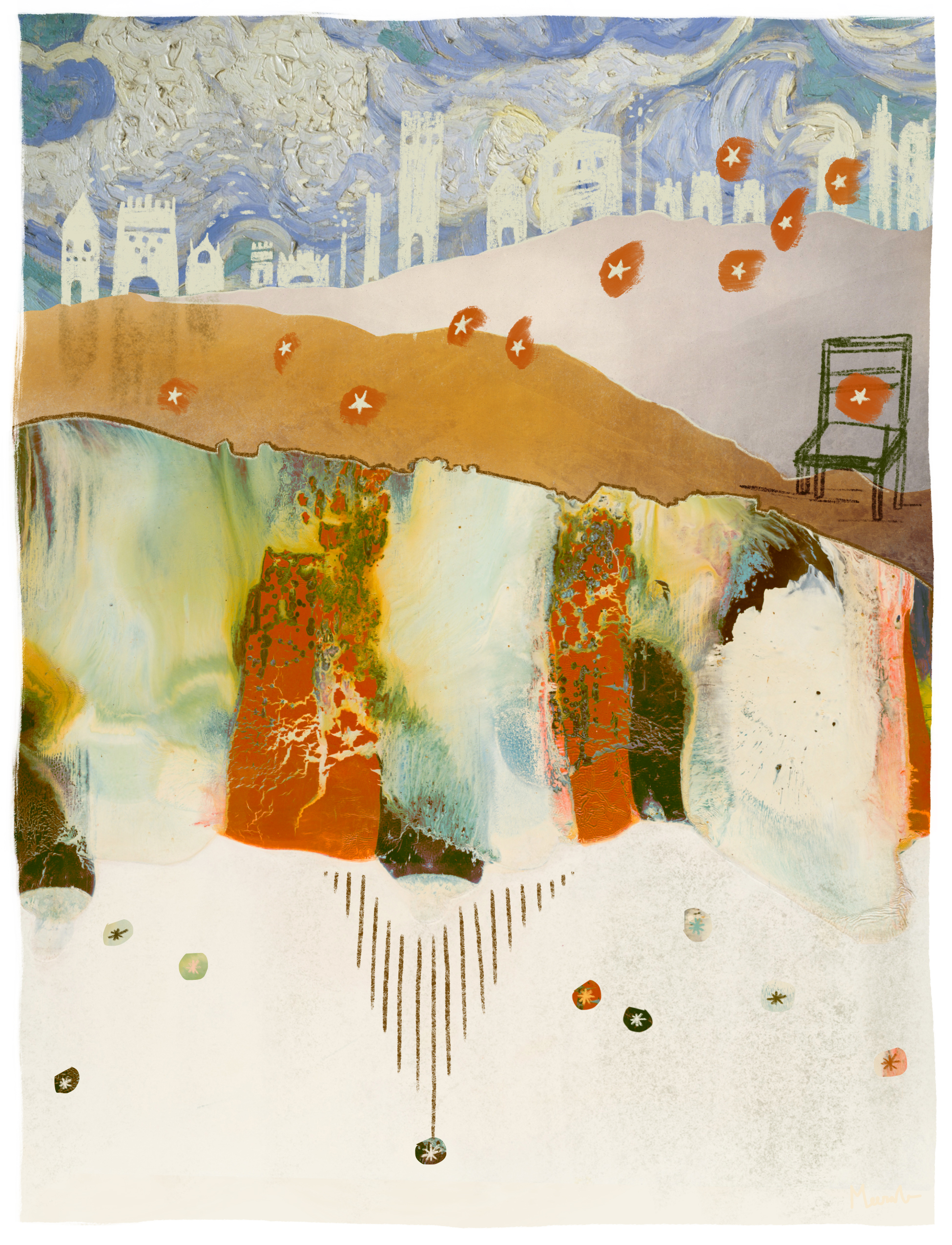
Artwork by Meera Lee Patel
11 comments
Jan Priddy says:
Sep 15, 2026
When we first met my best friend told me her specialist said she had the second worst allergies in Washington State; she used to say how sorry she felt for the little boy in Spokane. My youngest granddaughter has a syndrome, the result of a rare random mutation she shares with her mother, who is mosaic and therefore only partially reveals some of the symptoms. There are now some 400 cases identified in the world. I have myself perhaps undiagnosed neurodivergence. All this to say, though I cannot claim to know how you feel—only you know that—I admire your courage. Thank you for your candor and for refusing to pretend that somehow it’s all better.
Krista Raspor says:
Sep 23, 2026
Jan,
Thanks so much for reading and sharing your thoughts <3 really appreciate it!
Hayley says:
Sep 19, 2026
Thank you for sharing this, it really touched my heart. Hiding our imperfections is exhausting and depressing. You are beautiful to God and to me.
Krista Raspor says:
Sep 23, 2026
Hayley,
It’s so exhausting! Thanks so much for reading. God bless <3
MK McGee says:
Sep 22, 2026
This is a really beautiful piece of writing. Thank you for leaning into vulnerability to write it. I’m grateful you shared this. You helped us see you, and it’s a beautiful thing. Thank you.
Krista Raspor says:
Sep 30, 2026
Thank you for reading and for your kind words MK!
Krista Raspor says:
Sep 30, 2026
Thank you for reading and for your kind words MK!
Jennifer says:
Oct 1, 2026
One thing I count on is feeling imperfect.
I love your writing!
The craft, the story telling, the vulnerability.
A stunning piece.
Thank you.
Krista Raspor says:
Oct 6, 2026
Wow. Thanks so much Jennifer. Really appreciate you taking the time to read this piece.
JQ says:
Oct 3, 2026
I love you’re writing style, deep, transparent—honest.
Beautiful piece.
Krista Raspor says:
Oct 6, 2026
Thank you so much JQ 🙂 And thank you for reading! Appreciate you.