
 Like a snowman, one of my twins suggests—looping first around the cracked basketball court and playground equipment, then the large parking lot where caregivers line up early, some in pickups, some in indistinguishable SUVs, one in a Cybertruck. Adults fall into phones as they wait to collect their middle schoolers, who are banned from carrying their own phones to class.
Our walk is crunchy with newly dropped leaves, and my boys relish the rustle, notice the variety of color, observe the world the way I’ve taught them to. The twins say they hope their brother, my eldest, remembers to bring his fleece home today. A leaf pile awaits.
So far this year, my sixth grader has lost his planner, library book, ruler, eraser, and the squishy cube he uses to ease anxiety. He’s misplaced his water bottle twice and fleece once. Like phones, backpacks are banned. Once children arrive at their lockers in the morning, they must select what they need for first period and balance it all—binder, notebook, folder, planner, pencil case, water, maybe a calculator or sketchpad—in their hands. After each class, they have only two minutes to return to their lockers and exchange the necessary supplies for the next. I get how the eraser didn’t make it.
The school has banned backpacks because backpacks can hide phones, drugs, and guns. If a child is going to wield a weapon, he’d have to do it before the homeroom bell.
Last week, a rumor spread through our parent community. An eighth grader, we heard, penned a hit list on Snapchat. The principal keeps messaging the parent body to scold us for gossiping. But we go on messaging each other, rumoring whether, in the absence of more information, there’s a kernel of truth to the hit list story. One parent in our Facebook group suggested that it might be carried out in a few weeks, on Halloween, and now I can’t decide whether my son should attend that day, dressed as Sir Gawain. He’s not allowed to carry his toy sword to school.
I know sudden loss. My father was killed when I was six. I often imagine the countless other cars on the highway that evening and speculate about the math that sent the drunk driver’s hood into a single windshield: his.
Looking at the line of waiting cars, faces aglow with blue-white phone light, I consider the same odds. Which state, which town, which school? When will it happen here? Who among us will lament, if only my daughter had a cold, if only my son had overslept, if only the kid had aimed three inches to the left.
My son walks into and out of school with a teacher, because his anxiety is profound and navigating the hallways alone overwhelms him. But I don’t know how to parse this particular anxiety for my sons. I don’t know how to explain there’s as much danger on Snapchat as there is on the sidewalk. I don’t know how to teach them to notice signs of trouble without also filling them with fear. What I do know is that after my father died, my then-single mother hand-sewed my Halloween costume and sent me with a plastic pumpkin into the dark.
The phone in my pocket buzzes. I try not to check my phone during walks with the twins, but later I’ll see the messages from the principal: your children will be safe at school; we held a lockdown drill today; intramural signups are open!
For now, we crunch along, naming the colors carrot and egg yolk and plum, until the last bell rings, until we climb into the car and wait for my eldest son’s teacher to return him to us.
___
Suzanne Farrell Smith’s books include Small Off Things: Meditations from an Anxious Mind, an essay collection; The Memory Sessions, a memoir about searching for lost childhood memory; and The Writing Shop, a teaching guidebook. She won a Pushcart for her essay “If You Find a Mouse on a Glue Trap,” published in Brevity. With a BA from Trinity College, an MA from The New School, and an MFA from Vermont College of Fine Arts, Suzanne teaches at Westport Writers’ Workshop. She lives in a creek-cut valley in Connecticut with her husband, three sons, and three cats.
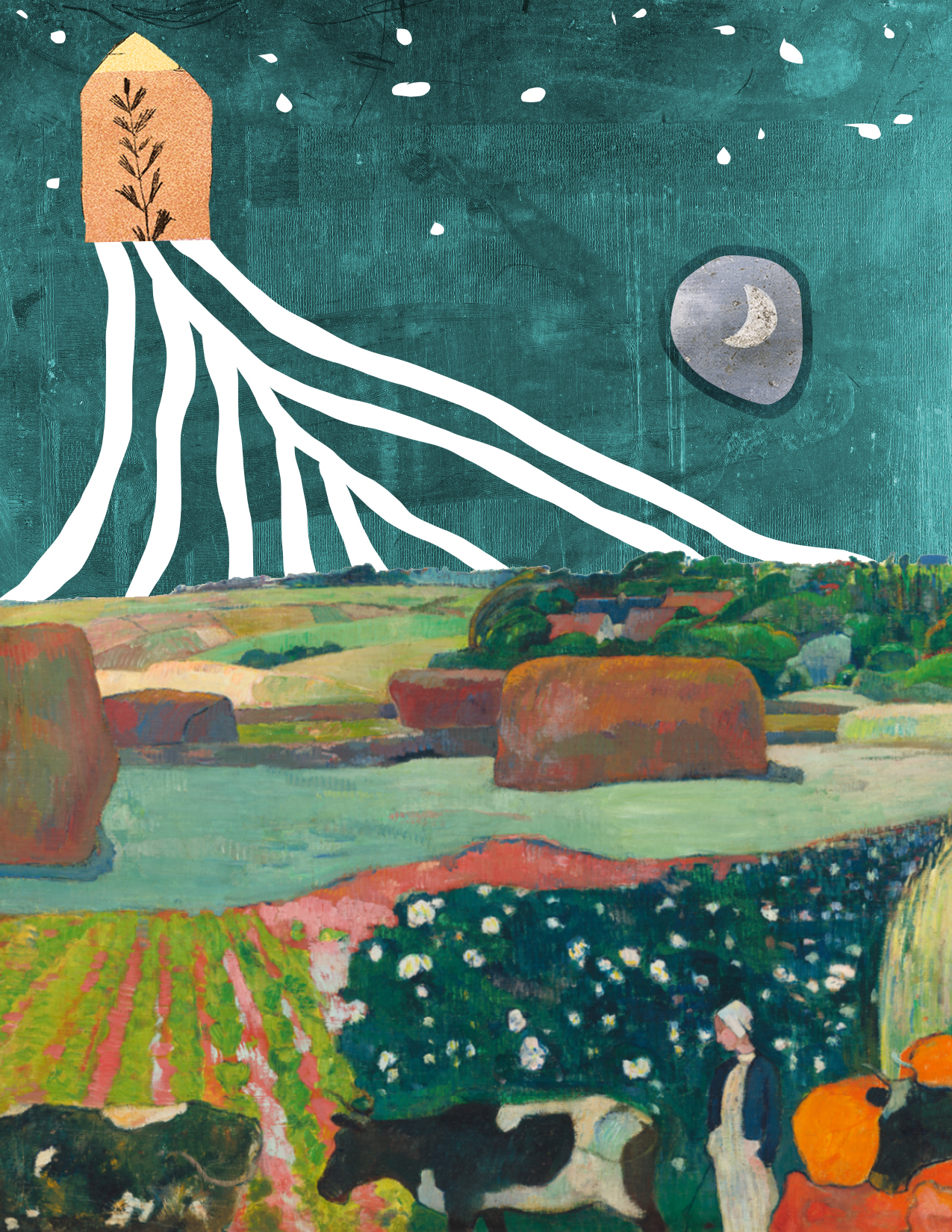
Artwork by Meera Lee Patel
20 comments
Dinty W Moore says:
Sep 15, 2026
So strong and brutal. The anxiety is indeed overwhelming at times.
Suzanne Farrell Smith says:
Sep 17, 2026
Thank you, Dinty. The anxiety is overwhelming, and somehow feels routine too.
MK McGee says:
Sep 16, 2026
Powerful! A strong mediation on such an intractable issue. Thank you.
Suzanne Farrell Smith says:
Sep 17, 2026
Thank you for reading. “Intractable” is the perfect word here.
Diane says:
Sep 17, 2026
Wow!
Suzanne Farrell Smith says:
Sep 17, 2026
Thank you so much for reading, Diane.
Sarah Barbo says:
Sep 17, 2026
Thank you for giving voice to what the thousands of us, maybe millions, have running through heads every single weekday morning of the school year. It seems unsustainable, madness even, but like your piece, in life the beauty is right alongside the potential horror. And we go on.
Suzanne Farrell Smith says:
Sep 17, 2026
Part of my morning routine is memorizing what the boys wear to school. How perfectly stated: “And we go on.”
Marcia Aldrich says:
Sep 17, 2026
You capture the current parental state of trying to teach caution and navigating anxiety. Such a difficult time. Thank you.
Suzanne Farrell Smith says:
Sep 18, 2026
Thank you. Difficult and with no clear path or answers.
Catherine Bourassa says:
Sep 18, 2026
Wow!! I didn’t think about these things when my now adult children were in school. I now have grandchildren and feel all this angst for them and what they have to navigate. Loved thies piece.
Suzanne Farrell Smith says:
Sep 18, 2026
Thank you so much for reading. I think of the verb “navigate” a lot. So many obstacles, many of them completely unexpected.
Maria Stylianou says:
Sep 18, 2026
Such a poignant, raw and beautifully honest piece. There is so much courage and vulnerability in this. Thank you for sharing this with us.
And tell the boys my favorite leaf color is plum!
Suzanne Farrell Smith says:
Sep 21, 2026
Thank you so much. Our walks through those leaves are a treasure.
Minh Nguyễn says:
Sep 19, 2026
Suzanne, This resonated deeply with me. The figure-eight you walk with your sons says everything about the loop we’re all stuck in right now, circling the same fears without ever landing on them. The pumpkin sent into the dark stayed with me long after I finished reading. Thank you for writing this.
Suzanne Farrell Smith says:
Sep 21, 2026
Thank you so much. It does feel stubborn and endless.
Emily says:
Sep 20, 2026
Love this, Suzanne. I can deeply relate.
Suzanne Farrell Smith says:
Sep 23, 2026
Thank you so much for reading, Emily.
Jake S says:
Sep 22, 2026
This is an incredible piece of writing. Unflinching and powerful. It’s both vivid in my mind and visceral in my emotional response.
Suzanne Farrell Smith says:
Sep 23, 2026
I really appreciate your comments, Jake.