
 A veil like a tomb for the body before it is burned, before it is buried, last rites before decay.
White is what’s left of the night. Broken promises. Buckets of milk.
My grandfather’s body was wrapped in yards of clean white cloth the morning after he died, his nostrils stuffed with cotton. Mango leaves garlanded around his neck, limestone chalked on their deep green surfaces in stark contrast to his skin, like a pinhole camera pierced through leather: cold, dark, creased.
White is the color of guilt—of the last time I saw him breathing, of the last time I stood by the foot of his bed, my nose scrunched at the stench of his age, his sickness, his decay. There were six hours between my home and his, the life I lived in Delhi and what was left of his own in the outskirts of Budaun. White was the color behind my eyes as he asked me to stay, as he begged me don’t go, as I took those final inevitable steps away.
I did not wash the weathered veil of his body, I did not touch his skin as he lay in the center of the courtyard or wrap the last of his memory in the tactility of care, of preparation. Around him, bodies surged with tears, with emotion, with sorrow spreading from skin to skin. I did not feel their grief on my shoulder. Instead, I sat alone in the crowd of white-cloaked mourners, with whatever memory I could conjure of his laughter above the din.
White is the color of his hair, of the thick crown on his head, the soft strands that ran down his back and shoulders, the downy fur along the ridges of his ears. I know because I have felt them, my legs wrapped around his shoulders, my hands resting on his head. Other times, my feet in step with his, small fist nestled in the coarseness of his palm, popsicle sweat mingling in the shared stickiness of summer walks and warm evening air.
To me, his corpse in antyesti looked just as he had in life. This man, who always wore white on white on white as if preparing for his death, as if accepting the fate that was woven into his clothes. To me, nothing felt out of place until he had been lifted away on the backs of my uncles and cousins and the narrow shoulders of my father, whose head bent beneath the weight as if in prayer, not sorrow.
Somewhere in the crowd, there was a cry from my little brother, still a child in a sea of men, reaching out, calling for familiarity, for a hand to pull him ashore. White is the sound of his voice, of a grief not yet realized. I consider lifting my hand, wrapping my fingers around his and letting him crawl into the loose ends of sarees, pushing him into the dangling arms of our mother and grandmother and taking his place in the procession of men that will snake down the dusty path to the cremation grounds beyond.
My mother does not tell me, you are not a son, but I can see in her weary eyes that women do not belong where they will take his body, where the gods will claim the only father who has ever held me in our home. Instead, my brother will go where I cannot, his reluctance matched in my restraint, to say goodbye to a man he hardly knew. Only then do the tears come.
This may or may not be the root of my othering, the beginning of my anger. The first time I could see our religion and our traditions held no place for me. This may or may not mark the path for who I became, because in my memory his death and what came after are shrouded in ivory, in milk, in cotton and clouds.
Because in the end, I did not watch them carry his body wrapped in a cocoon of cotton down to the banks of the holy river. I did not watch the wood piled up onto the funeral pyre, the body placed at the top, the fire lit, flames lapping up in rivulets, reaching up to the heavens.
___
Shraya Singh is an ex-engineer, writer, and teacher from India and loves frogs, Lord of the Rings memes, and epic fantasy. She has received scholarships and support for her writing from Yaddo, Community of Writers, Tin House, Artist Trust, and the Quillisascut Writers’ Workshop and you can read some of her work in The Southern Review, The Rumpus, Pacifica Literary Review amongst others. Currently, she is a PhD student in Creative Writing at the University of Houston where she also serves as Managing Editor for Gulf Coast.
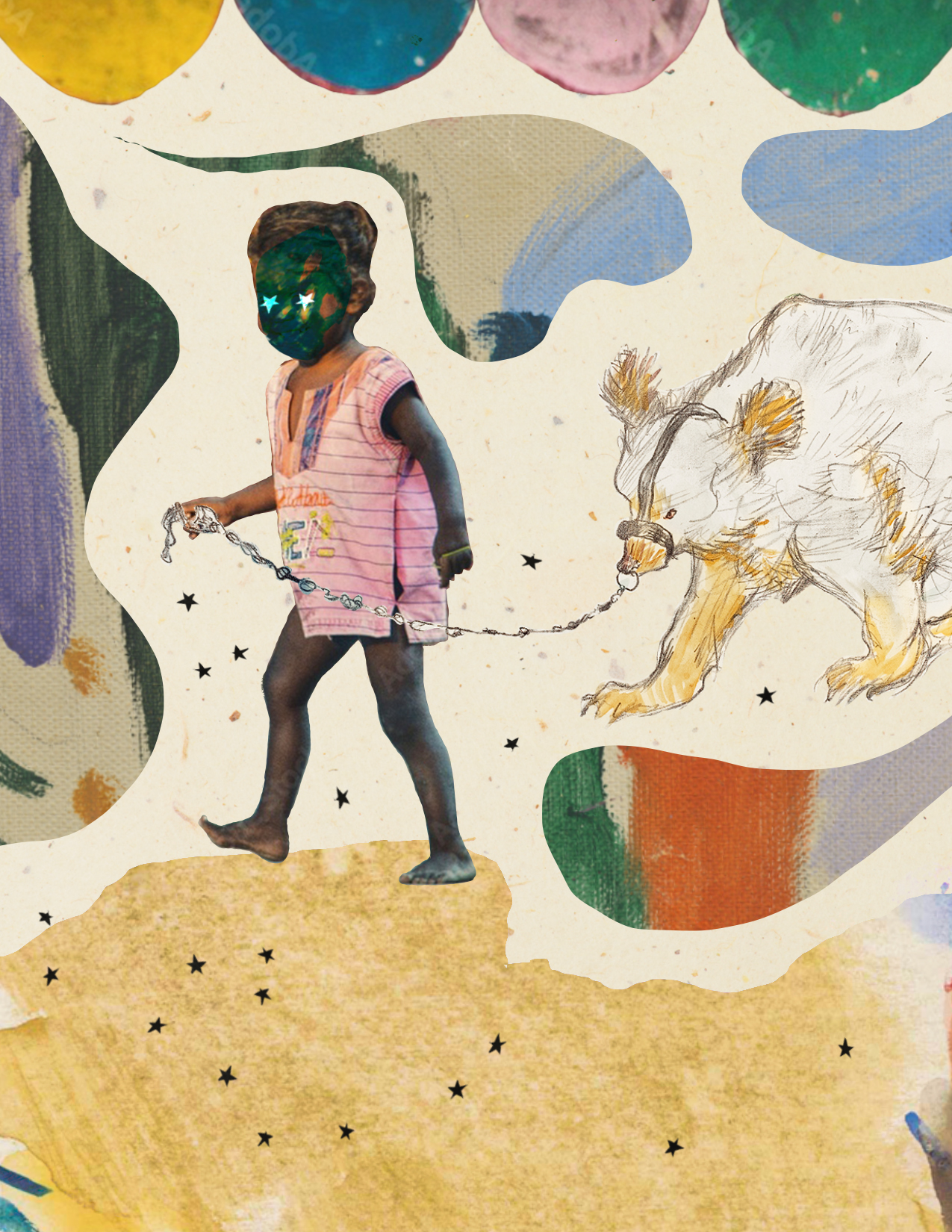
Artwork by Meera Lee Patel
5 comments
Tina Kuykendall says:
Sep 15, 2026
Lovely exploration of a time when innocence became reality. This juxtaposes white with the fire/innocence and rage. Most people can look back and think of a moment when the veil of childhood was lifted.
Minh Nguyễn says:
Sep 19, 2026
The grief here isn’t only for your grandfather, it’s for the place at his funeral you were never given. Watching your brother “hardly knew him” and still cross into the rites you couldn’t is the essay’s real wound, and ending on everything you didn’t get to watch, the pyre, the flames, the river, makes that absence the whole shape of the piece rather than an aside in it. White carries all of it: the cloth, the milk, the guilt, the grief not yet realized. Deeply moving, and a devastating way to write your way back into a room you were shut out of.
MK McGee says:
Sep 28, 2026
I so enjoyed this piece. It was so embodied in its description, and I did not know it would end the way it did.
Marianna Marlowe says:
Sep 28, 2026
Poetic and moving and righteously angry. Beautiful piece.
Becky Gesteland says:
Sep 30, 2026
A lovely, powerful piece. Thank you for sharing it with us ❤️