
 I’m on a miniature riverboat or a Chinese junk, or a wooden houseboat with a paddle wheel. I’m captain and crew. The inlet is crowded with vessels from earlier ages of sea-going vessels: hollowed out canoes, reed boats, a schooner, a pinnace. There’s an old dock and a pier and it’s crowded with vendors hawking their wares, but I can’t tell what they’re selling, and I don’t care. I have to take a piss, desperately. There’s nothing more important than that. As my boat floats closer to the berth, I hop off onto the dock and run to the first door I see, which I think may be a room with a toilet in it. Lo and behold it is.
It’s a dank little space, a lightbulb barely glowing hanging by a frayed cord. The floor tiles are chipped and sticky and there’s a roach of course, on the wall in the shadows beneath the slowly dripping sink.
I am not alone. There’s an older man here, looking at himself in the mirror, liking what he sees, combing his thinning gray hair with a hard black comb. It’s my father. I’m sure of it. I’m sure of it because I know what my father looks like. The big ears, sly grin, sparking blue eyes, loud sports jacket. Dan Wallace. It’s him. Except it can’t be him because he’s dead and has been for over 25 years.
I flush the toilet, but he doesn’t take his eyes from the mirror. It’s as if, of the two of us, I’m the one who’s not there.
***
I’ve never dreamed about my father, until I had this one. I have seen him a few times though, mostly around town, in the years right after he died.
Once I saw him driving down the highway in an Electra, the window down, cigarette in one hand and the wheel in the other. Another time he was in a vintage light blue Cadillac. Then I saw him in New York City, from across the street, disappearing around the corner. I was sure it was him. I would have bet on it if it weren’t for the fact that he wasn’t alive.
Supposedly. It’s sounds farfetched, but I thought it was possible he may have faked his own death.
I wouldn’t have put it past him. He was a businessman who railed against governmental regulations and intrusion. He liked making money and he hated paying taxes and did everything legal and not legal not to. He was being sued for sexual harassment. His only son had quit the business to become a writer. All his kids were asking him for shit and he was tired of it. Faking his death would free him from all of this. He would be dead, but not so dead that he couldn’t enjoy the fruits of his labor and deception. Watching him drive by I could see how happy he was, how free. He had avoided the two things everyone says are unavoidable: death and taxes.
Now I’ve found him, but he’s still pretending he doesn’t see me. Like we’re strangers.
“What’s your name?” I ask him.
He smiles. “My name is Harry,” he says.
I almost laugh. “Your name’s not Harry.” He turns and gives me the once over and what he sees does not impress him.
“What’s wrong with your pants?” he says.
I look and he’s right: the cuffs are too long. They’re dragging the ground.
“I’ve lost some weight,” I say.
He turns back to the mirror and brushes some light dandruff from his shoulders. It’s his reflection that talks to me now. “You’re about to lose more,” it says.
I never saw my father dead. His ashes were buried in a golden box. I cried all day the day of his funeral, even though we had been distant for many years.
But I never saw him dead. He was 67, the same age as his own father. I’m 65. It’s ridiculous, of course, all of this. I know he’s dead. I know it. But there are times, even if it’s just for a few seconds, I think he could be alive. I don’t really believe it, though. I also don’t believe he came to me in this dream to tell me that I, too, was going to die. That’s also ridiculous. But for a few seconds every day, maybe even more than a few, I think he did.
___
Daniel Wallace is the author of six novels, including Big Fish, one memoir, This Isn’t Going to End Well, and, most recently, a collection of flash fiction, Beneath the Moon and Long Dead Stars, from Bull City Press. He lives in Chapel Hill and teaches at the University of North Carolina. More information at his website,
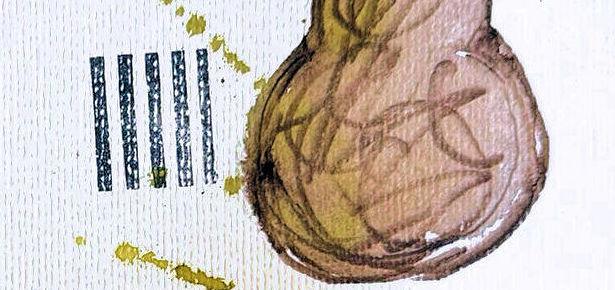
Artwork by Dinty W. Moore
8 comments
Jan Priddy says:
May 20, 2025
It’s harder when you feel you owe them something or they owe you. You want to balance that obligation and it’s too late for amends. Sometimes I saw my mother, saw her little purple car; but my dad? I wouldn’t hear the terrible story my mother wanted to tell me, I didn’t cry while I sat beside his hospital bred; I didn’t cry when he died; I didn’t cry when I finally put his ashes in the sea; I cried on a drive to work one morning when I thought, “Daddy will know,” and realized I could never ask him. I pulled over to the side of the highway and let the tears come.
loveflowershub says:
Jun 25, 2025
Wow, this was such a wild and wonderfully strange ride! ?? I felt like I was drifting through a dream—half historical seafaring fantasy, half urgent modern-day crisis. The mix of poetic scenery and very real bodily urgency had me hooked (and laughing). Loved how grounded and human it felt, even in such a surreal setting. Would definitely read more of your floating adventures!
Luxeus says:
Aug 6, 2025
masterpiece indeed
kelwinn says:
Aug 8, 2025
This piece beautifully captures the complex emotions of loss, memory, and unresolved feelings toward a parent. The vivid imagery of the riverboat and the haunting presence of the father in the dream creates an atmosphere that lingers long after reading. It’s rare to find writing that so honestly explores the tension between acceptance and denial, especially around someone as significant as a parent. The metaphor of the golden box is particularly striking — a symbol of closure that still feels incomplete. Thank you for sharing such a raw and personal story that many readers will deeply relate to.
Dhruv says:
Sep 4, 2025
This piece is haunting, dreamlike, and deeply resonant. The line between memory, grief, and imagination blurs so effortlessly here—it’s that strange emotional space where our loved ones live after they’re gone, half-remembered but vividly present. I especially appreciated the way the mundane (a dingy bathroom, dragging pants) is juxtaposed with the surreal return of the father figure. It says so much about unresolved relationships and how loss lingers in unexpected ways. Beautifully written, and it stays with you long after reading. Thank you for sharing this.
Amelia Rose says:
Sep 7, 2025
What a beautifully written and thought-provoking piece. The metaphor of the “Golden Box” is so powerful—it perfectly captures that tension between cherished memories and the need to move forward. Your writing made me reflect on what my own golden box might contain. Thank you for sharing such a poignant and relatable concept. It truly resonates.
Cora Schenberg says:
Sep 12, 2025
Just to say I loved this piece so much!
Christina Rossi says:
Jun 20, 2026
What’s funny is I was looking for father in the index, settled for aging and came upon this. All about a father. Mine died several years ago. I feel such an urge to write about him.