
My mother was a champion bowler in Thailand. This was not what I knew of her. I knew only her expectations of me to be the perfect Thai boy. I knew her distaste for blonde American women she feared would seduce her son. I knew her distrust of the world she found herself in, a world of white faces and mackerel in a can. There were many things I didn’t know about my mother when I was ten. She was what she was supposed to be. My mother.
At El-Mar Bowling Alley, I wanted to show her what I could do with the pins. I had bowled once before, at Dan Braun’s birthday party. There, I had rolled the ball off the bumpers, knocking the pins over in a thunderous crash. I liked the sound of a bowling alley. I felt in control of the weather, the rumble of the ball on the wood floor like the coming of a storm, and the hollow explosion of the pins, distant lightning. At the bowling alley, men swore and smoked and drank.
My mother wore a light pink polo, jeans, and a golf visor. She put on a lot of powder to cover up the acne she got at 50. She poured Vapex, a strong smelling vapor rub, into her handkerchief, and covered her nose, complaining of the haze of smoke that floated over the lanes. My mother was the only woman in the place. We were the only non-white patrons.
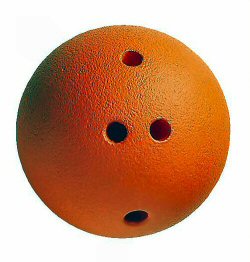
I told her to watch me. I told her I was good. I set up, took sloppy and uneven steps, and lobbed my orange ball onto the lane with a loud thud. This time there were no bumpers. My ball veered straight for the gutter.
My mother said to try again. I did, and for the next nine frames, not one ball hit one pin. Embarrassed, I sat next to her. I put my head on her shoulder. She patted it for a while and said bowling wasn’t an easy game.
My mother rose from her chair and said she wanted to try. She changed her shoes. She picked a ball from the rack, one splattered with colors. When she was ready, she lined herself up to the pins, the ball at eye level. In five concise steps, she brought the ball back, dipped her knees and released it smoothly, as if her hand was an extension of the floor. The ball started on the right side of the lane and curled into the center. Strike.
She bowled again and knocked down more pins. She told me about her nearly perfect game, how in Thailand she was unbeatable.
I listened, amazed that my mother could bowl a 200, that she was good at something beyond what mothers were supposed to be good at, like cooking and punishing and sewing. I clapped. I said she should stop being a mother and become a bowler.
As she changed her shoes, a man with dark hair and a mustache approached our lane. In one hand he had a cigarette and a beer. He kept looking back at his buddies a few lanes over, all huddling and whispering. I stood beside my mother, wary of any stranger. My mother’s smile disappeared. She rose off the chair.
“Hi,” said the man.
My mother nodded.
“My friends over there,” he pointed behind him, “well, we would like to thank you.” His mustache twitched.
My mother pulled me closer to her leg, hugging her purse to her chest.
He began to talk slower, over-enunciating his words, repeating again. “We … would … like … to … thank…”
I tugged on my mother’s arm, but she stood frozen.
“… you … for … making … a… good … chop …suey. You people make good food.”
The man looked back again, toasted his beer at his friends, laughing smoke from his lips.
My mother grabbed my hand and took one step toward the man. In that instant, I saw in her face the same resolve she had when she spanked, the same resolve when she scolded. In that instant, I thought my mother was going to hit the man. And for a moment, I thought the man saw the same thing in her eyes, and his smile disappeared from his face. Quickly, she smiled—too bright, too large—and said, “You’re welcome.”
Ira Sukrungruang has just finished Talk Thai, a memoir about growing up as a first-generation Thai-American on Chicago’s south side. He is the co-editor of What Are You Looking At? The First Fat Fiction Anthology and Scoot Over, Skinny: A Fat Nonfiction Anthology. His essays, stories, and poems have appeared in numerous publications.
3 comments
Grace Laymance says:
Jan 24, 2022
It’s interesting how he conveys the message of not knowing who our parents are when we’re so young, even though we think we do.
Second paragraph does a really good job of imagery, like comparing bowling to the weather and being in control. Includes a lot of well placed and distinguished words to make the reader feel like they’re there.
The way the author tells the story makes me feel like i am there, like when they started talking about the man, and the racist remark he said to the mother. It made me mad and scared for the mom and the son.
The author told such a short, seemingly meaningless story in a way that made me feel like how he felt in that moment. I never really understood writing like that until now.
Talia Stephen says:
Aug 19, 2025
I love how he chose to describe his mom in the most innocent ways as most do in life. The irony of how he thought his mom was a regular mom who didn’t have any hobbies other than being a good mom is funny because it relates to real life with not knowing how our parents are outside of them taking care of us. The author gave good imagery and made me feel like I was there living in the moment with him since being in a bowling alley before is very relatable. I also thought the fact that he thought he was a good bowler and was using the bumpers to hit pins. His mom randomly wanting to bowl and acting like she was not interested in him participating in this was very comical. It gave a warm feeling to know that has mom was more than just a good mom but also a mom with good personality and background. As the story is coming to an end and the man comes up to them with a joke that wasn’t funny I felt uneasy for them. I love how the mother stood her ground and kept her reaction classy. She let loose a bit with her response and it made me feel appreciative of her being the bigger person in the situation even though it wasn’t a very pleasant conversation. In conclusion this story gave me good emotions and I loved how the writer was very specific in his details.
Mahin Bin Shahid Ullah says:
Mar 4, 2026
I really like how the author slowly reveals who his mother truly is. At first, he describes her only as strict and traditional, but the bowling scene changes everything. It shows that parents have talents and past lives that we don’t always see as children. That moment made me realize how limited a child’s perspective can be.
The imagery in the bowling alley is especially powerful. The comparison between the sound of the bowling ball and a storm makes the scene feel intense and alive. It helps the reader understand how important that moment felt to him.
When the man makes the racist comment, the mood shifts instantly. I felt uncomfortable and tense, especially when it seemed like the mother might react. That moment shows both her strength and the way she has learned to protect herself and her son. Even though it’s a small interaction, it carries a lot of emotional weight. The author turns an ordinary memory into something meaningful and powerful.